
In the latest Tenthpin whitepaper, "Life Sciences Trends 2026: The Era of the Smarter Operating Model", we cover the top ten trends in Life Sciences. Here's an extract that covers the big three which we think deserve their own time in the spotlight.
1. Supply chain sovereignty for critical materials
The biotech industry's dependence on highly concentrated supply nodes has evolved from an efficiency optimization to a strategic vulnerability. The data points are stark and deeply concerning for anyone responsible for ensuring continuity of supply. China produces approximately 70 percent of global active pharmaceutical ingredients and more than 80 percent of the key chemical inputs required for antibiotic production as for instance highlighted by the US Senate Special Committee on Aging and a 2025 testimony that was reported to the U.S.-China Economic and Security Review Commission. Critical rare earth elements including yttrium and neodymium, which are essential for certain advanced manufacturing processes and medical devices, remain more than 85 percent concentrated in just two geographic regions. This degree of concentration creates systemic fragility that a single geopolitical event, natural disaster, or policy change could expose catastrophically. Both bulk API materials as well as rare elements increase the pressure on supply chains.
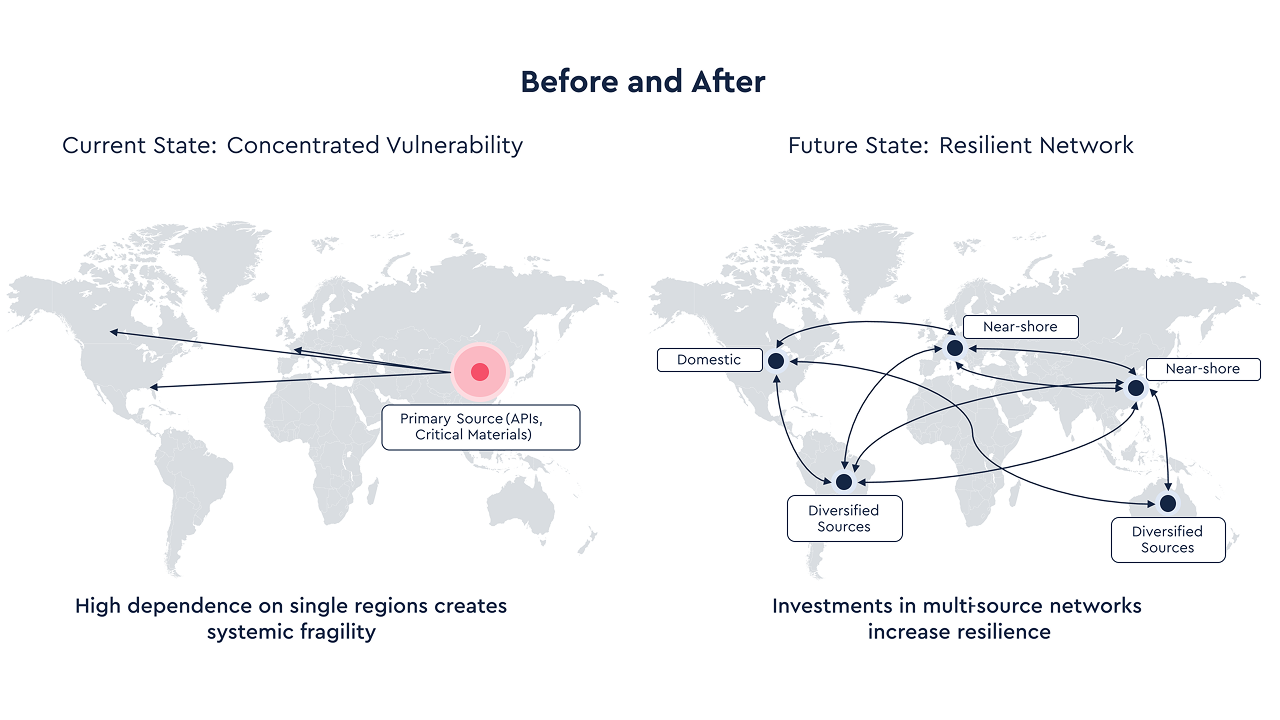
The operational response requires fundamental rethinking of sourcing strategy. Life Sciences companies are investing in domestic or near-shore API synthesis capabilities even though these facilities cost substantially more to build and operate than sourcing from established Asian suppliers. Long-term contracts for critical minerals and materials are being negotiated years in advance, accepting less favorable pricing in exchange for supply security. Excipient sourcing, traditionally an afterthought focused purely on cost, now requires the same diversification discipline as active ingredients. Every single-source dependency gets systematically identified and evaluated for risk.
Quality assurance must evolve in parallel. As companies qualify second and third-tier suppliers who may have less manufacturing experience or more limited quality systems, the rigor of supplier quality audits and ongoing monitoring intensifies. Scenario-based inventory policies replace simple min-max reorder approaches, with safety stock levels dynamically adjusted based on real-time assessment of geopolitical risk, supplier financial health, and lead-time trends. Digital twins of upstream supply chains, once limited to internal manufacturing operations, now extend backward to critical suppliers, creating early warning systems for potential disruptions.
The trade-offs are significant and unavoidable. Based on industry benchmarking and client experience, cost of goods increases by 15 to 25 percent in many cases when moving from optimized single-source supply chains to more resilient multi-source networks, though the range varies considerably depending on product complexity, geographic footprint, and starting point. Working capital requirements rise as safety stocks expand. Complexity multiplies as quality systems must manage multiple suppliers for each critical material. However, these costs pale in comparison to the business impact of being unable to supply markets due to a disruption. The question is not whether to invest in resilience but how much resilience the organization's risk tolerance and financial position can support.
2. Operationalizing advanced therapies
Advanced therapies medicinal products (ATMPs) including cell and gene therapies, mRNA therapeutics, and radiopharmaceuticals, are undergoing a fundamental transition from artisanal production to industrial manufacturing. The first generation of these therapies required highly manual processes, patient-specific manufacturing runs, and weeks of turnaround time.
Allogeneic CAR-T approaches are now reducing turnaround from weeks to days by eliminating patient-specific manufacturing. Base editing and prime editing technologies enable multi-gene modifications with precision that surpasses earlier CRISPR approaches, opening therapeutic possibilities that seemed unreachable with first-generation tools. Radiopharmaceuticals, seen by many as the next major frontier in personalized medicine, present their own industrialization challenges given the short half-lives of radioactive isotopes and the need for manufacturing facilities close to treatment sites. Meanwhile, mRNA technology, despite facing regulatory headwinds in some jurisdictions, continues to mature as a platform with applications extending well beyond vaccines into therapeutics for cancer, rare diseases, and protein replacement.
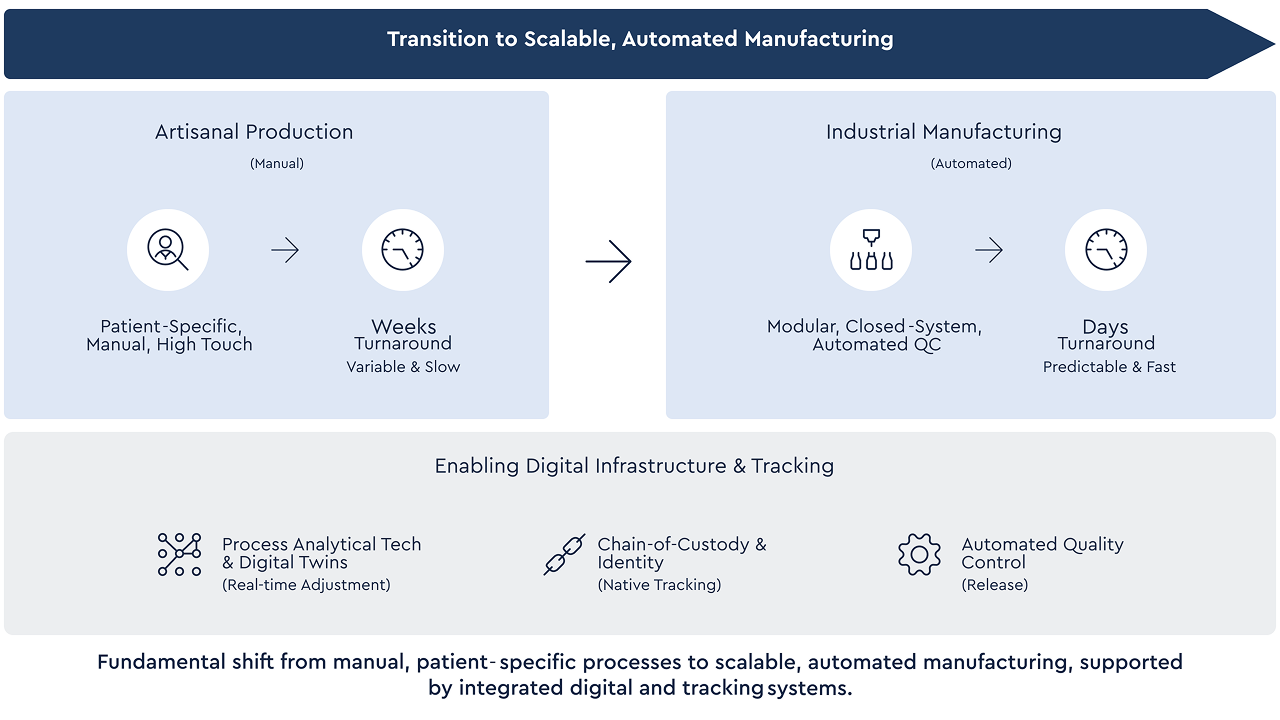
However, vector manufacturing (the production of viral vectors essential for gene delivery) remains a critical bottleneck constraining the entire field.
The operational response requires complete reconceptualization of manufacturing strategy:
- Modular, closed-system facilities reduce contamination risk and enable more predictable production
- Automated quality control release replaces labor-intensive manual testing
- Process analytical technology and digital twin modeling enable real-time process adjustment and yield prediction
- Chain-of-custody and chain-of-identity tracking become native infrastructure rather than add-on compliance measures
- Every unit of product must be traceable from raw materials through to patient administration, with complete documentation of every processing step and quality attribute
The geography of advanced therapy manufacturing is also evolving. India's cell and gene therapy outsourcing (CGTO) sector is emerging as a significant force, with Life Sciences companies investing heavily in manufacturing capabilities, regulatory expertise, and quality systems designed to meet Western standards. This mirrors India's earlier trajectory in small molecule and biologics contract manufacturing, and could reshape the cost equation for advanced therapy production; though questions remain about technology transfer complexity and the logistical challenges of therapies with short shelf lives.
The pathway from promising science to commercial therapy remains treacherous, and the landscape is littered with biotechs developing novel approaches that have little realistic chance of reaching patients. The industrialization challenge is simply too demanding for many smaller companies to overcome on their own. This creates a strategic opening for large pharmaceutical companies with the manufacturing expertise, regulatory relationships, and capital to acquire promising science and solve the scale-up puzzle. The pent-up demand for acquisitions noted elsewhere in this analysis may find its most compelling opportunities in advanced therapies, where the gap between scientific potential and commercial readiness is widest and where big pharma's operational capabilities are most differentiated. The Life Sciences companies that can efficiently identify, acquire, and industrialize promising advanced therapy assets, will capture disproportionate value as this field matures.
The technical challenges remain substantial. Raw material supply chains for advanced therapy production are still maturing, with quality variability and availability constraints common. Vector yields remain inconsistent and are exquisitely sensitive to process parameters. Regulatory standards for manufacturing and quality control continue to evolve as agencies learn alongside the industry. The companies succeeding in this space combine deep biological understanding with manufacturing engineering discipline, treating advanced therapy production as an engineering problem that demands the same rigor as semiconductor manufacturing rather than as an extension of traditional pharmaceutical production.
3. Technological convergence through agentic AI
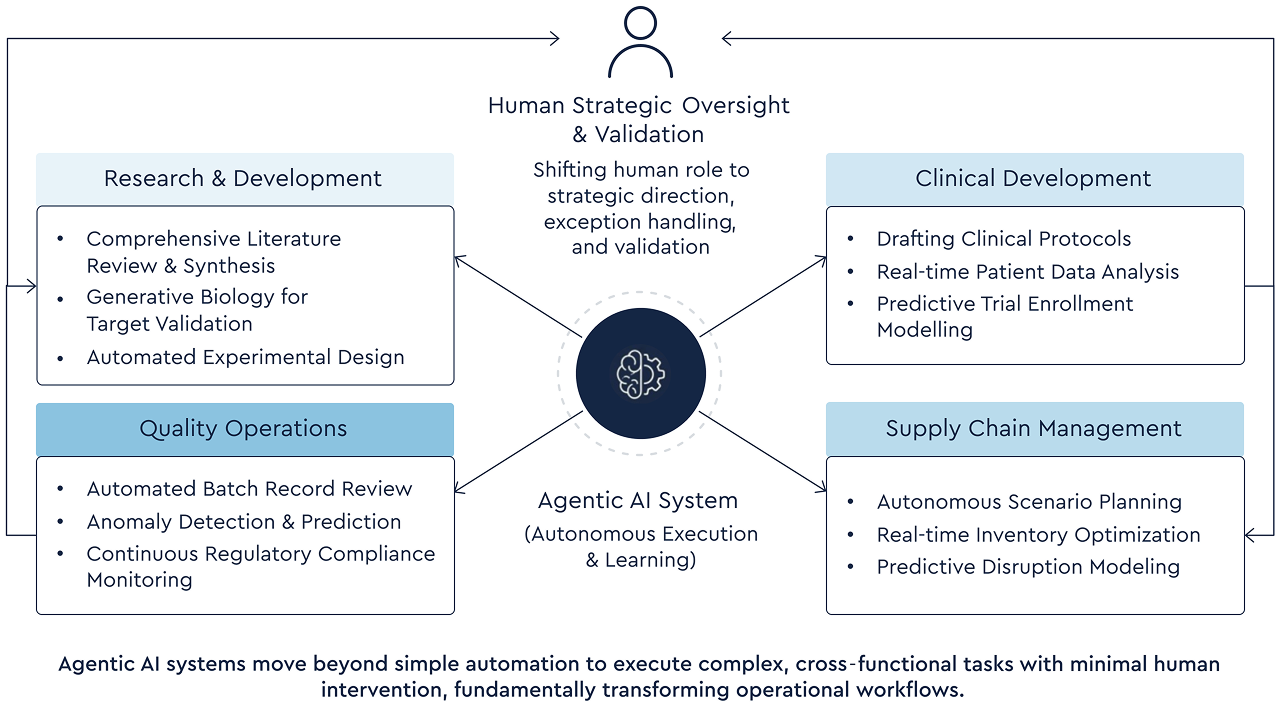
2026 marks the first time agentic artificial intelligence systems operate routinely within regulated Life Sciences operations rather than existing as experimental pilots. These are not simple automation tools or decision-support systems. Agentic AI systems execute complex tasks across research, clinical development, quality operations, and supply chain management with minimal human intervention. These systems:
- Perform comprehensive literature review and synthesis, identifying relevant research across millions of publications and extracting key findings
- Draft clinical protocols based on therapeutic area precedent, regulatory guidance, and internal company standards
- Conduct supply chain scenario planning, evaluating thousands of potential disruptions and optimization opportunities
- Review electronic batch records and detect quality anomalies that would take human reviewers hours to identify
Generative biology tools specifically designed for drug discovery accelerate target validation and molecular design. Where medicinal chemists once manually designed and prioritized molecules for synthesis, AI systems now generate hundreds of candidates optimized against multiple objectives, predict their properties with increasing accuracy, and suggest synthesis routes. The best human chemists remain essential, but their role shifts toward strategic direction and validation rather than routine design.
The operational requirements for deploying agentic AI in regulated environments are substantial and non-negotiable. Standard operating procedures must be completely redesigned to define what AI systems can do autonomously, what requires human review, and what remains exclusively human responsibility. Every AI action must be logged with sufficient detail to support regulatory inspection. Validation frameworks must ensure AI systems perform consistently and reliably within their defined operating parameters. AI integrity programs must prevent data poisoning, where malicious actors corrupt training data; model drift, where AI performance degrades over time; and adversarial attacks designed to cause specific failures.
The workforce implications are profound and require deliberate talent strategy rather than reactive hiring. Life Sciences organizations need computational biologists who understand both biological systems and machine learning. AI stewards who ensure models remain properly calibrated and compliant. Model auditors who can validate AI decision-making for regulatory purposes. The companies managing this transition most effectively invest heavily in training existing staff while selectively hiring specialized talent, recognizing that the institutional knowledge existing employees possess remains invaluable even as the technical tools evolve dramatically.
The nature of work itself transforms fundamentally:
- When AI handles literature review and synthesis, what does a medical affairs scientist do?
- When AI drafts regulatory documents, what becomes of the regulatory writer's role?
- When AI reviews batch records, how does the quality professional add value?
The answer is not that these roles disappear but that they evolve toward higher-order activities: strategic judgment, exception handling, stakeholder engagement, and the kind of integrative thinking that connects insights across domains. Organizations must redesign job architectures, performance metrics, and career pathways to reflect these changes. They must also address the psychological dimensions of workforce transformation; helping employees see AI augmentation as capability expansion rather than displacement threat, and creating clear progression paths that reward the new skills the AI-enabled environment demands.
Life Sciences companies that neglect this human dimension of AI deployment will find their technology investments undermined by:
- Workforce resistance
- Attrition of critical talent
- Failure to capture the productivity gains that AI makes possible
The risks demand serious attention. Intellectual property can leak through AI systems if proper safeguards aren't implemented. Multi-agent failures, where multiple AI systems interact in unexpected ways, create novel failure modes. Ethical compliance becomes more complex when AI systems make decisions affecting patients. The organizations that successfully deploy agentic AI treat these risks as serious engineering challenges requiring systematic mitigation rather than as reasons to avoid the technology entirely.




INSIGHTS
Related insights


As we work closely with clients in the pharmaceutical industry, we have identified three major trends that are playing a...


Accounting and financial reporting has been guided by regulations for nearly a century. Major crises like The Great Depression...

2026 exposes a fundamental disconnect in the Life Sciences industry. While biotech innovation is accelerating exponentially, the...