
Life Sciences organizations need a few smart ingredients to successfully automate ESG (Environmental, Social, and Governance) reporting. Why? Because ESG data is generated across numerous functions and processes, resulting in inconsistent data, unclear data ownership, and a reliance on various technology solutions. Another significant challenge is generating a roadmap to get there.
At Tenthpin, we know how to develop the right roadmap using a holistic approach that truly delivers on ESG priorities. Already, we have worked with leading pharma clients to provide suitable routes and options for ESG reporting. Here’s a brief glimpse of the options we presented:
- Accelerated approach: With additional investment in digitalization of transactional processes at source, automated reporting can be increased to roadmap 75% of the KPIs and enables the use of Sustainability Data Hub (SDH) for reporting on over 80% of data points.
- Balanced approach: By leveraging existing infrastructure, the automation of approximately 50% of the KPIs can be achieved and the use of Sustainability Data Hub (SDH) for reporting of over 75% of the data points.
- Minimal viable approach: The automation of 26% of the KPIs and reporting via SDH for just over 40% of the data points. Information is merged manually.
In this blog, we’ll show you how to measure your maturity and derive a prioritized roadmap with a lighthouse architecture.
Three blockers to building strong ESG reporting
Life Sciences leaders are increasingly focused on delivering ESG reports and disclosures that meet evolving regulatory expectations, while providing transparent, meaningful insights to stakeholders. A strong roadmap enables Life Sciences organizations to approach this proactively, turning compliance into a driver of operational excellence and trust.
Bringing together data from across the Life Sciences organization in a reliable and consistent way demands strong governance, well-defined processes, integrated technology, and an understanding of ESG within employees; similar to what’s required for high-quality financial reporting.
A successful ESG reporting roadmap ensures the following three potential roadblocks are cleared:
-
Build consistent and reliable processes: At the beginning of the journey to solid reporting, our clients ESG data is often captured manually, calculated differently across teams, or sourced from systems that were never designed for sustainability reporting. Your organizations can strengthen ESG reporting by standardizing how data is captured, calculated, and managed across teams. Establishing common definitions, aligned methodologies, and harmonized units of measure helps ensure ESG metrics are reliable, comparable, and audit-ready.
-
Assign clear ownership and governance: ESG reporting spans finance, procurement, operations, R&D, quality, and HR, yet accountability for data accuracy and maintenance is frequently undefined. Ensure clear data ownership and governance structures are in place, so your organizations can improve data validation, resolve discrepancies more efficiently, and respond with greater agility to regulatory or audit requirements.
-
Strive for integrated technology solutions: Many organizations rely on a patchwork of spreadsheets, point solutions, and legacy systems to manage ESG data. While individual tools may address specific needs, the lack of integration creates fragmented data flows, manual handoffs, and limited end-to-end traceability. By aligning your systems and reducing reliance on disconnected tools, your organization can improve end-to-end traceability and unlock greater value from automation and analytics.
Building a suitable and robust roadmap the Tenthpin way
We have been elevating our client's sustainability reporting using our tried and tested capability-based approach. Tenthpin’s approach has six ESG reporting capabilities. When these capabilities are fully in place, our clients can produce robust and trustworthy ESG reports that not only meet compliance requirements but also serve as a solid foundation for management decision-making. Together, they cover the full spectrum of ESG reporting; from capturing high-quality data to embedding an understanding of sustainability metrics into the organization while aligning the technology landscape necessary for realization.
The secret sauce of our approach is that each of the capabilities in our framework uses the 3 dimensions processes, organizational adoption and technical maturity.
-
Process and governance: Establishing clear processes and governance frameworks
-
People and culture: Defining an effective ESG operating model with roles and accountability
-
Data and technology: Leveraging technology and unified data to ensure consistency of reported metrics
Our clients' existing ESG reporting capabilities are assessed along these three dimensions. So, what are the capabilities we consider to be the core for robust ESG reporting?
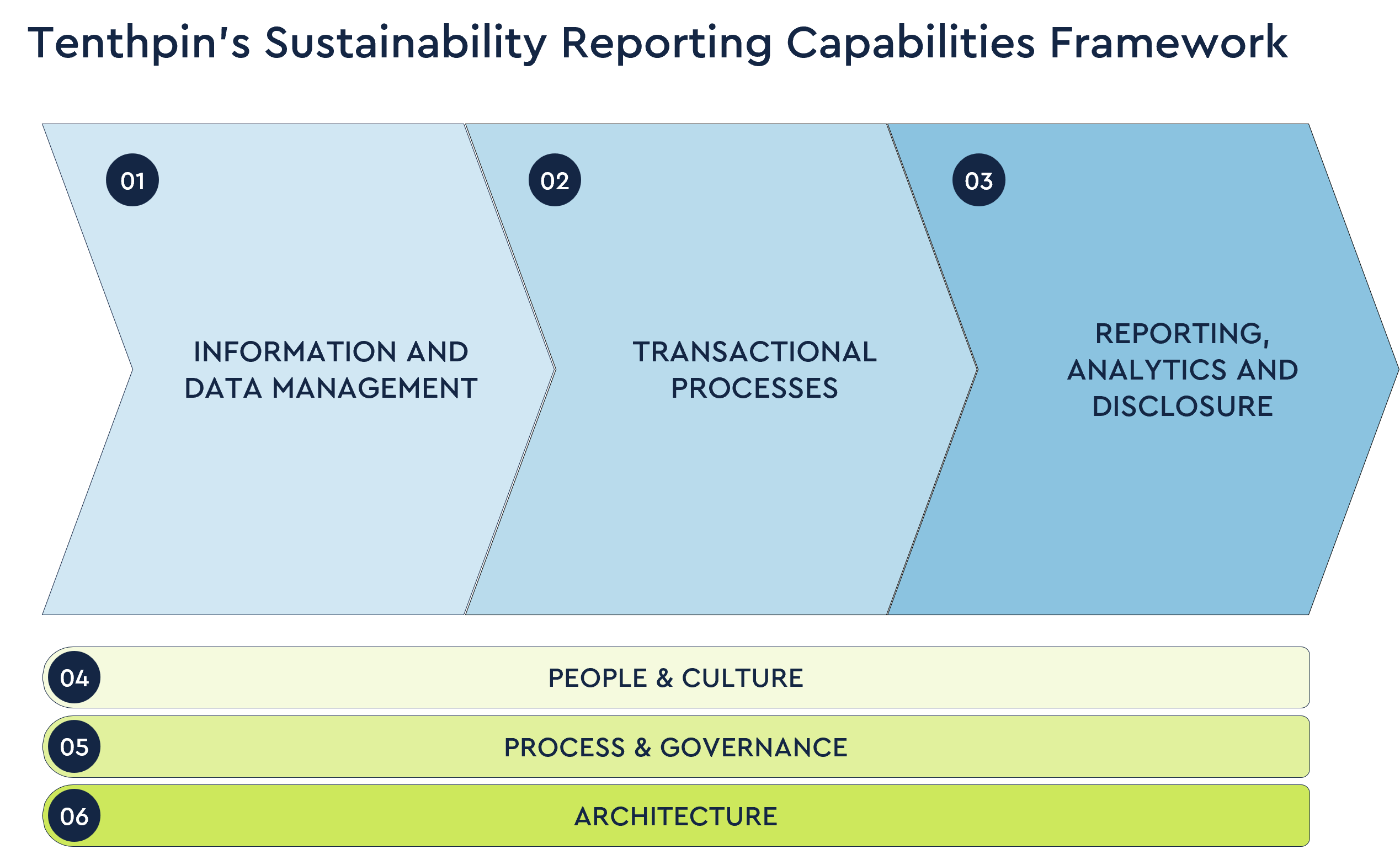
Each of the six capabilities focuses on key questions that are critical to understanding the needs of our clients:
One: Information and data management capabilities
- How mature is your organization’s data strategy in integrating internal and external sustainability data?
- Does it ensure accuracy, consistency, and automation across ESG reporting processes?
Two: Transactional process capabilities
- To what extent are sustainability-relevant data points embedded in your global transactional processes?
- How scalable and standardized are these processes across business units and regions?
Three: Reporting, analytics and disclosure capabilities
- How effectively does your organization leverage reporting and analytics to translate ESG data into actionable insights?
- Is it supported by robust processes, controls, and traceability from data capture to disclosure?
Four: People and culture capabilities
- How well are employees engaged, trained, and aligned around the organization’s sustainability framework, roles, and KPIs?
- Does it drive accountability and a shared ESG mindset?
Five: Process and governance capabilities
- How consistently are ESG processes governed across the organization?
- Does your operating model enable prioritization, standardization, and collaboration across business and technology functions?
Six: System and data architecture
- How effectively does your enterprise architecture framework support ESG goals through integrated data, application, and technology architectures?
- Do they enable scalable and future-proof sustainability reporting?
When we work with our clients, our first step is to thoroughly assess their ESG reporting maturity. Based on the results of this gap assessment, we establish a prioritized roadmap, revealing steps to take for organizational setup and leveraging existing or implementing new technology.
By understanding where a client stands across each capability, we can effectively align business and IT strategies; paving the way toward a scalable and future-proof ESG reporting framework.
Conclusion
Automating ESG reporting isn’t just about technology. It’s about building a holistic approach and roadmap that can ease concerns, demonstrating that implementing the system is the right approach.
In our upcoming “Automated ESG Reporting series”, we’ll discuss more on establishing clear processes and governance frameworks; developing a community of practice to ensure ownership; and how to build on technology already in place to define a unified data model
We’ll also share practical tips and show how you can strengthen your own ESG reporting journey.
*The authors would like to thank Cal Loudon, Adviser at Tenthpin, for his support and insights that were critical in the writing of this article.




INSIGHTS
Related insights


Accounting and financial reporting has been guided by regulations for nearly a century. Major crises like The Great Depression...

How life sciences companies can optimize their US Transparency Reporting Solution Pharmaceutical organizations often face a...


We have previously discussed the benefits and business cases of real-world data (RWD) and real-world evidence (RWE). However, the...