
Large Language Models (LLMs) are growing in maturity. And across the Life Sciences value chain, this maturity can bring enormous benefits in areas where AI is already transforming processes, like drug discovery and more.
But lack of trust in the data that feeds these machines is holding back progress. Rather than being the enabler that they hoped for, Life Sciences organizations are finding the lack of trust in their data is leaving AI initiatives dead locked and struggling to bear the fruits that were promised.
For progress to be made, Life Sciences organizations need to move beyond asking this one question when starting on the path: “can we build AI?”. Instead, they need to take a more rounded approach by asking questions like:
- “Do we have the right data”
- “Can we trust the data behind it?”
- “Can we safely use it for AI?”
Until the trust gap in data is closed, Life Sciences companies will struggle to scale their AI roadmaps. Turning their AI ambitions to ones of scalability starts with trusted, fit-for-purpose data. Without it, AI roadmaps will remain blocked.
We’ve noticed the trust gap when talking to clients across the value chain. That’s why Tenthpin has designed frameworks that start to close the gap; enabling AI ambitions across the highly regulated Life Sciences sector. In this blog, we’ll go into more detail about the trust gap and how our approach helps to make AI at scale possible for the Life Sciences sector.
What is the “trust gap” in data and AI?
The trust gap sits between what Life Sciences organizations want AI to do and what they can safely put into production.
On one side is AI ambition. Think generative AI, predictive models, automation and increasingly autonomous agents. On the other is AI at scale. Think solutions that can operate with the appropriate controls, evidence, governance and oversight to be used confidently in real-world Life Sciences environments.
The challenge is not necessarily a lack of data. In many Life Sciences organizations, there is an abundance of it. The real challenge is knowing whether that data is suitable for the particular AI use case that the company wants to put into practice.
Building trust begins with the Six Dimensions of AI Data Readiness
With the trust gap explained, filling that gap is the next part. Through experiences of dealing with the challenges of industry leaders and clients, we’ve found an evidence-based approach to determine whether Life Sciences data is ready for AI at scale.
We call it the Six Dimensions of AI Data Readiness. The dimensions can be summed up as:
- Quality: Is the data accurate, complete, consistent and fit for its intended purpose?
- Semantics: Are data elements clearly defined and understood consistently across systems, functions and teams?
- Lineage: Can the origin, transformation and movement of data be traced throughout its lifecycle?
- Governance: Are ownership, accountability, access and decision-making responsibilities clearly established?
- Compliance: Can the data be used in a way that meets applicable regulatory, privacy, security and data-integrity requirements?
- AI suitability: Is the data appropriate for the specific AI use case, model or application being considered?
Together, these six dimensions provide a repeatable diagnostic for determining whether Life Sciences data is accessible, trustworthy, governed, compliant and fit for its intended AI use. Why is this important? Because there is no universal definition of “AI-ready data.” Data that is suitable for one application may not be suitable for another. Simple as that. The readiness question needs to be connected to the intended use.
That makes AI Data Readiness more than a one-off data-quality exercise. It can become the front door into broader Data & AI transformation engagements, providing an evidence-based starting point for deciding where investment, remediation and transformation are actually needed.
Trust in data cannot happen without evidence and confidence
When it comes to AI, taking one step back can be the best way to move four steps forward. Life Sciences organizations can move quickly from an interesting AI use case to a proof of concept. But moving from a promising pilot to a solution that is trusted and used in real-world operations requires a different level of confidence.
That confidence needs evidence.
Rather than asking, “Are we ready for AI?”, Life Sciences organizations need to establish why they are or are not ready, where the gaps are, what those gaps mean for a specific use case and what should happen next.
This is the purpose of an evidence-based AI Data Readiness assessment. At Tenthpin, we’ve got the following assessment in place to bring confidence to the data used to accelerate AI initiatives:
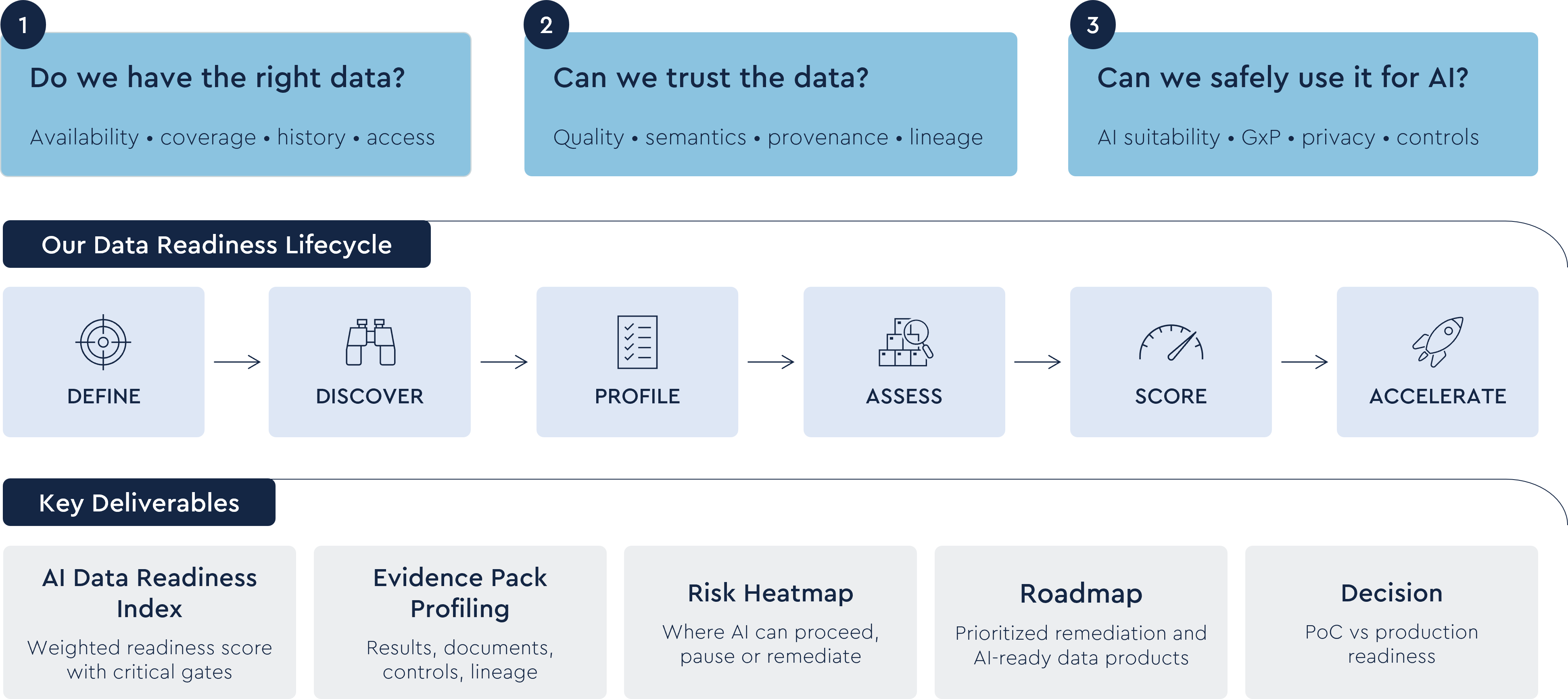
Answering the three questions requires a structured process that can determine whether AI can proceed. The Data Readiness Lifecycle provides that structure:
- Define: Defining the intended outcome provides the context for everything that follows. Data should not be assessed in isolation; its readiness depends on what it is ultimately expected to support.
- Discover: Identify the relevant data sources, systems and datasets. Understand where the data resides and how it can be accessed. This creates a clearer picture of the data landscape and helps identify potential gaps before deeper assessment begins.
- Profile: Examine the characteristics of the data itself. This includes understanding its quality, semantics, provenance and lineage, as well as the availability, coverage and history identified during the initial assessment. The objective is to establish an evidence base rather than relying on assumptions about the data.
- Assess: The data is then assessed against the requirements of the intended AI use case. This is where considerations such as AI suitability, GxP, privacy and controls become particularly important. The result is a more complete view of both the strengths and risks associated with the data.
- Score: The findings are brought together through an AI Data Readiness Index — a weighted readiness score that highlights critical gaps. Rather than producing a simple “ready” or “not ready” answer, the index provides a structured view of readiness and highlights the areas that require attention.
- Accelerate: The final step turns the assessment into action. The results identify where AI can proceed, where remediation is required and what needs to happen next. This enables organizations to prioritize their efforts rather than attempting to address every data issue at once.
The output of the Data Readiness Lifecycle is more than a data assessment. It is a set of practical deliverables designed to help organizations make decisions about their AI ambitions. These deliverables are:
- AI Data Readiness Index (ADRI): A weighted readiness score provides an overall view of AI data readiness while highlighting critical gates that may prevent an initiative from progressing.
- Evidence pack: The evidence pack brings together the results, documentation, controls and lineage that underpin the readiness assessment. This is important because trust requires more than an opinion that data is “good enough.” Decision-makers need evidence that supports the assessment.
- Risk heatmap: The risk heatmap shows where AI can proceed, where remediation is required and where additional investigation may be needed. This makes the findings easier to translate into practical priorities.
- Roadmap: The roadmap turns identified gaps into a prioritized plan for remediation and the development of AI-ready data products. Rather than treating every issue equally, it provides a path forward based on what matters most for the intended AI use cases.
- Decision: Ultimately, the assessment supports a clear decision: can the use case move from proof of concept toward production, or are further readiness activities required? This distinction is critical. A successful AI proof of concept does not automatically mean an organization is ready to deploy that solution in a real-world Life Sciences environment.
Conclusion
The AI conversation is increasingly moving beyond experimentation. Generative AI, predictive AI, automation and AI agents are creating opportunities to change how Life Sciences organizations operate. But the ability to deploy these technologies at scale depends on more than the capabilities of the AI itself.
It depends on the data underneath it.
Organizations need to know that they have the right data. That they can trust it. And that they can use it safely for the intended AI application. They need evidence to understand where they stand, visibility of the risks and a practical roadmap for addressing the gaps.
That is what makes AI Data Readiness an important first step in the journey toward AI at scale.
As we’ve shown in the blog. the trust gap can be closed when Life Sciences organizations have the right process, and framework offering in place. We ensure, through our AI Data Readiness offering, that Life Sciences can trust their data to make their AI ambitions a reality. It gives them the evidence and confidence they need to not only take the next steps but to see their AI initiatives move out of the sandbox and applied in real-world scenarios.



INSIGHTS
Related insights


AI is no longer a future ambition in Life Sciences, it is here. Executives are under pressure to move beyond pilots and deliver...


A Tenthpin report on digital leadership in the ongoing transformation of Life Sciences. Digital Leadership in the Ongoing...

Article published by Tenthpin Management Consultants in CIOReview