.png)
SAP S/4HANA transformations are among the largest and most business-critical initiatives organizations undertake. They also carry significant risk. A recent survey shows that almost 60% of companies who have already completed the transformation exceeded the planned schedule.
For CIOs, the challenge is no longer simply implementing SAP S/4HANA. It is delivering transformation with confidence, predictability, and compliance.
In Life Sciences, the stakes are even higher. Regulatory requirements, validated systems, complex manufacturing environments, global supply chains, and extensive legacy landscapes leave little room for error. A delayed deployment, poor data quality, or inadequate testing can impact far more than project timelines. It can disrupt operations, create compliance risks, and delay the realization of business value.
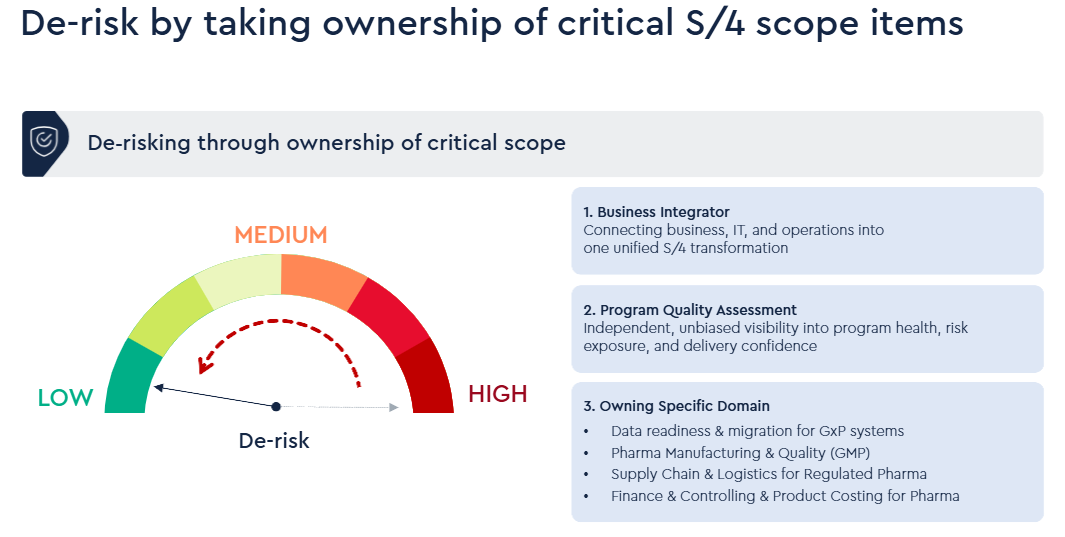
This is why de-risking cannot be treated as a separate workstream or a final checkpoint before go-live. It must be embedded into every phase of the transformation, from strategy and design through build, testing, deployment, and long-term operations.
Having supported SAP S/4HANA transformations across numerous Life Sciences organizations, we've seen firsthand where projects encounter difficulties and, more importantly, what differentiates successful programs from those that struggle. While every transformation is unique, the underlying risk patterns are remarkably consistent.
In our previous blog, we explored the most common SAP S/4HANA implementation pitfalls (and how to avoid them). In this entry, we build on that foundation by examining the five risks that every Life Sciences CIO should actively manage, along with a practical playbook for reducing risk throughout the transformation journey.
The five risks we see every CIO struggle to manage
Across the SAP S/4HANA programs we've delivered for Life Sciences organizations, we've found that the specific challenges may vary, but the underlying risks rarely do. Whether supporting global pharmaceutical manufacturers, biotech innovators, MedTech companies, or CDMOs, the same themes and threats consistently emerge.
Recognizing these risks early allows Life Sciences organizations to make informed decisions, prioritize mitigation efforts, and avoid costly issues later. Based on our delivery experience, these are the five risks every CIO should be prepared to manage:
1. Putting data quality first
High-quality data is the foundation of every successful ERP transformation. There’s no getting around that statement. Data is the new oil after all. It drives compliance, supply chain resilience, process automation, and the works. High quality data directly dictates operational efficiency and audit-readiness. On the other hand, poor master data, incomplete migration strategies, and inconsistent data governance; each of these can undermine operational efficiency, reporting accuracy, and regulatory compliance long after go-live. No one wants that. Good quality data, therefore, can be the difference between a successful implementation and a bad one.
2. Protecting critical processes and controls
SAP S/4HANA transformations frequently involve redesigning business processes across multiple functions. This naturally presents many opportunities. Like standardization and efficiency to name a few. But it also introduces the risk of disrupting critical controls that support manufacturing, quality, finance, and supply chain operations. The drawbacks to this are obvious. Without clear governance and process ownership, Life Sciences organizations may inadvertently weaken internal controls or introduce inconsistencies across global operations. This in turn can be lead to critical results.
3. Bringing people along the journey
Even the best-designed technology will fail to deliver value if people are not prepared to adopt it. It’s as simple as that. All the time and effort applied to the SAP S/4HANA transformation, only to be squandered by resistance from the very people who need it most. But there’s an uncomfortable fact that not everybody wants to admit. Building organizational readiness is just as important as configuring the solution itself. Otherwise, it’s a non-starter. That’s why successful transformations have effective governance, executive sponsorship, clear decision-making, comprehensive training, and structured change management ingrained from the start.
4. Embedding compliance from the start
Compliance cannot be bolted onto an SAP S/4HANA program at the end of implementation. That’s just not how compliance works. Validation planning, documentation, audit readiness, and GxP requirements should be incorporated into the transformation from the earliest design decisions. What happens if not? Well, waiting until testing or deployment to address compliance often creates unnecessary rework, delays, and increased validation effort. All of which ensures that the SAP S/4HANA implementation doesn’t make the strong start that it should.
5. Keeping technology complexity under control
Modern SAP landscapes are increasingly interconnected. There’s no way getting around that. SAP S/4HANA must integrate with manufacturing execution systems, laboratory platforms, quality applications, planning solutions, and numerous third-party technologies. Otherwise, failure might be closer in range than success. Changes to architecture, cloud adoption strategies, etc, all introduce technical complexity that must be managed throughout the program. Having a firm grasp on this challenge is more critical than ever during the rapid transformations taking place in Life Sciences with AI and more.
The practical CIO playbook that works
Knowing the risks of SAP S/4HANA implementation is one thing, but if CIOs in Life Sciences really want to navigate them with confidence, then they need to think bigger. That’s where a playbook comes in. A set of rules, established strategies, standard operating procedures, and more to ensure their SAP S/4HANA transformation journey is uninterrupted and seamless.
Below are the stages that CIOs in Life Sciences organizations should follow when making SAP S/4HANA a core part of their framework:
Phase 1: Design (Build risk out before it enters the program)
Many of the most expensive implementation issues originate during the design phase. This isn’t surprising. Decisions made early around business processes, governance, data structures, etc often determine how much complexity/risk will carry into later stages.
For CIOs, this is the time to establish compliance-by-design principles, define validation strategies, identify process owners, and agree on governance structures. By embedding compliance and governance into the program architecture from the outset, Life Sciences organizations can significantly reduce downstream rework and avoid costly design changes later in the project. That way, risk is cut before the SAP S/4HANA journey is in full force.
Phase 2: Build and test (Validate the operating model, not just the system)
Testing should confirm far more than whether individual system functions work as expected across the SAP S/4HANA project. A robust testing strategy validates how people, processes, data, and technology work together across the entire ecosystem and enterprise.
It’s so important for CIOs to ensure testing happening over and over again. For Life Sciences organizations, testing also provides an opportunity to demonstrate that regulated processes continue to operate as intended while maintaining compliance requirements.
Phase 3: Deploy (Protect business continuity)
Go-live is often viewed as the finish line. But the uncomfortable truth is that go-live is one of the highest-risk stages of any SAP S/4HANA transformation. It’s a humbling thought; all that effort ready to be jeopardized right at the tail-end. Effective deployment depends on meticulous cutover planning, clear governance, well-defined escalation paths, and comprehensive business readiness across all impacted functions.
Hypercare should monitor operational performance, user adoption, process stability, and compliance to ensure that the Life Sciences organization continues to operate effectively during the transition. For Life Sciences companies, maintaining uninterrupted manufacturing, supply chain performance, and product quality during deployment is essential.
Phase 4: Sustain (Turn continuous improvement into continuous risk reduction)
Transformation does not end after go-live. Far from it. As Life Sciences organizations introduce new functionality, regulatory requirements evolve, and business priorities change, continuous governance becomes essential to maintaining compliance and maximizing the value of the SAP S/4HANA platform.
Leading organizations establish ongoing monitoring processes while continually optimizing business processes and strengthening governance. Why this approach? Because it enables organizations to move beyond project completion and build a resilient digital core that supports long-term business transformation. Something that all CIOs want to ensure.
Case study: Tenthpin helps Big Pharma company navigate data risks in SAP S/4HANA implementation
Let’s take a look at one of our most recent use cases involving a Big Pharma company looking to avoid the data risks that often slow down SAP S/4HANA transformation projects.
What was the challenge?
Our client was not only running several different legacy SAP ERP systems, but had initiated a SAP S/4HANA transformation with an ambition of transforming several entities into a single platform. This takes several years to complete.
Overall, the transformation program was huge, with a consulting company leading the entire program at the same time. Why? Because the sheer size of the program required the clients to obtain help for many areas where they couldn’t deliver alone.
Within the transformation project, data was one of the biggest challenges and one of its most critical parts. This is where our expertise would bear fruit.
What was the scope of the project?
We were selected as part of the data readiness team, supporting global scale data and enterprise structure design at the beginning of the project. We then continued with supporting data profiling and cleansing activities — especially for their initial target entities. Post profiling and cleansing, as the project moved into deployment phases, we further supported data transformation initiatives. What did this look like? Basically, we owned E2E Data Transformation from Cleanse to Data Migration to Post Load Reconciliation. Overall, our role was vital across the entire scope of the project.
What was the overall outcome?
The biggest result was risk reduction. By executing the high risk data challenge in our highly strategic advisory role — including how to cleanse data, profiling and actual execution as a qualitative outcome — we were able to leave a lasting and positive impact on the transformation project.
Our experts further established trusted enterprise data foundations for ERP transformation through data readiness, quality remediation, migration, and reconciliation. This application of our skillset ensured the reduction of legacy data issues by 50%, acceleration of deployment readiness by 30%, and enabled business adoption with high-quality, reliable data.
Conclusion
SAP S/4HANA transformations in Life Sciences are inherently complex, but complexity does not have to translate into unnecessary risk. The organizations that consistently achieve successful outcomes are those that embed de-risking into every stage of the transformation. From strategy and design through deployment and continuous improvement.
For CIOs, success depends on more than following a project plan. It requires combining deep SAP expertise with a thorough understanding of Life Sciences processes, regulatory requirements, and proven delivery practices. Established methodologies, pre-built Life Sciences content, industry-specific process models, and experienced consultants; all of this helps to reduce uncertainty, accelerate delivery, and improve the likelihood of achieving the core objectives.
Proactive planning, strong governance, rigorous testing, and continuous optimization form the foundation of a practical de-risking playbook. When these capabilities come together, Life Sciences organizations are better positioned to deliver SAP S/4HANA transformations that are compliant, on schedule, and create lasting business value.




INSIGHTS
Related insights
-1.png?width=756&height=458&name=Untitled%20design%20(26)-1.png)

SAP S/4HANA projects fail due to predictable issues. Think about data, scope, integration, and governance. All the usual...
Article published by Tenthpin Management Consultants in CIOReview

.png?width=756&height=458&name=Untitled%20design%20(24).png)
For CIOs, CFOs, and S/4HANA transformation leaders in the Life Sciences industry, the decision to migrate to SAP S/4HANA...